Table of Contents
If you’re running a construction business and your phone isn’t ringing as much as it should be, there’s a good chance your competitors are showing up on Google before you are. Local SEO for construction companies is the single most effective way to change that — and it doesn’t require a massive marketing budget to get results.
This guide breaks down exactly what you need to do to rank higher in local search, get into Google’s map pack, and start winning more jobs from customers searching for contractors in your area.
What Local SEO Actually Means for Construction Companies
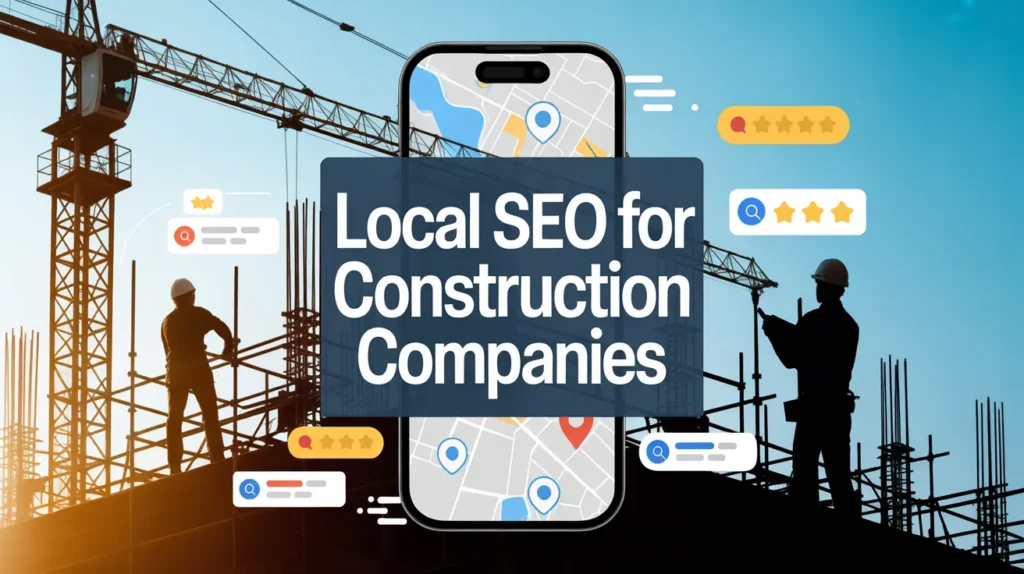
Local SEO is the process of optimising your online presence so your business appears when people nearby search for the services you offer. When someone types “construction company near me” or “home builder in [your city]” into Google, local SEO determines whether your business shows up or your competitor’s does.
For construction companies specifically, local SEO matters more than almost any other marketing channel. Your customers are always local. Nobody’s hiring a contractor from another city when there are qualified builders down the road. That means showing up in local search results isn’t just helpful — it’s where the majority of your new business comes from.
The three main places you want to appear are organic search results, the Google map pack (the three business listings that appear with a map at the top of local searches), and Google Business Profile listings. Getting all three working together is what separates construction companies that have a steady pipeline from those that rely entirely on word of mouth.
Setting Up and Optimising Your Google Business Profile
Your Google Business Profile is the foundation of local SEO for contractors. It’s free, it’s powerful, and most construction companies either don’t have one or haven’t properly optimised it.
Go to Google Business Profile, and either claim your existing listing or create a new one. Make sure every detail is accurate and complete — business name, address, phone number, website, and business hours. Consistency matters here because Google cross-references this information across the web.
Once your profile is live, these are the areas that make the biggest difference to your ranking and visibility:
- Business category: Choose “General Contractor” as your primary category, then add secondary categories that reflect your specific services, such as home builder, roofing contractor, or renovation company.
- Service areas: Add every city, town, and postcode you serve. This tells Google exactly where you want to appear in local searches.
- Photos: Upload genuine photos of your completed projects, your team, your equipment, and your office or yard if you have one. Profiles with photos get significantly more clicks than those without.
- Posts: Use the posts feature to share recent projects, promotions, or company news. Regular activity signals to Google that your business is active and engaged.
- Reviews: This is probably the single most impactful element of your Google Business Profile for contractors. More on this in the next section.
Why Reviews Are Your Most Powerful Local Ranking Signal
Google uses reviews as a major factor in determining map pack ranking for contractors. Businesses with more reviews and higher ratings consistently outrank those with fewer, even when other factors are similar.
The challenge for most construction companies is that customers don’t leave reviews unless they’re prompted. Make requesting reviews a standard part of your project completion process.
Send a follow-up message after every job is finished with a direct link to your Google review page. Make it as easy as possible — the fewer clicks required, the more likely they are to follow through.
Responding to every review matters too. Thank customers for positive feedback and address negative reviews professionally and constructively. Google sees active review management as a sign of a legitimate, engaged business, and potential customers are far more likely to call a company that responds to feedback than one that ignores it.
Aim for a consistent flow of new reviews rather than a sudden burst. Ten reviews over ten months look more natural and sustainable to Google’s algorithm than ten reviews in a single week.
How to Rank in the Google Map Pack as a Contractor
The map pack is the most valuable piece of real estate in local search. Those three listings that appear above the organic results with a map get the lion’s share of clicks for local searches, and getting your construction company into that group should be a top priority.
Map pack ranking for contractors comes down to three core factors that Google calls relevance, distance, and prominence.
Relevance is how well your business profile matches what the person searched for. This is where your business categories, service descriptions, and the keywords on your website all work together.
Distance is straightforward — Google factors in how close your business is to the person searching. You can’t change your location, but you can make sure your address and service areas are accurately listed to maximise your reach.
Prominence is where most of the optimisation work happens. It reflects how well-known and trusted your business is online, based on factors like the number and quality of your reviews, the consistency of your business information across the web, links to your website, and how active your Google Business Profile is.
Improving your prominence is an ongoing process, but the impact on your map pack ranking is significant and long-lasting.
Building Local Citations for Your Construction Business
Local citations are online mentions of your business name, address, and phone number — commonly referred to as NAP data. They appear on business directories, industry listings, and local websites, and they play an important role in building the prominence that helps you rank in local search.
Building local citations for your construction business means getting your NAP information listed accurately and consistently across key platforms. The most important ones to start with include:
- Yell.com
- Checkatrade
- TrustATrader
- Houzz
- Yelp
- Bing Places
- Apple Maps
The keyword here is consistency. Your business name, address, and phone number must be identical across every listing. Even small variations — like “St” versus “Street” or a different phone number format — can dilute the trust signals you’re sending to Google.
Once you’ve covered the major directories, look for local business associations, your local Chamber of Commerce website, and any industry-specific trade directories relevant to your type of construction work. Each accurate citation strengthens your local SEO footprint.
Optimising Your Website for Local Construction Searches
Your website and your Google Business Profile work as a team. A well-optimised website reinforces everything your profile signals to Google and helps you rank for a wider range of local search terms.
The most impactful on-site changes you can make are straightforward. Add your city or region to your homepage title tag and meta description. Create dedicated service pages for each type of work you offer — roofing, extensions, new builds, renovations — and include your location in the content naturally.
A page targeting “home extensions in Manchester” will rank for that specific search in a way a generic services page never will.
Add a footer to your website that includes your full NAP information on every page. This consistency reinforces your local relevance to Google and makes it easier for visitors to contact you.
If you serve multiple areas, consider creating individual location pages for each one. A page dedicated to your services in a specific town or city, with genuine content about your work in that area, can rank independently and significantly expand your local visibility.
Getting Local Backlinks That Actually Help Your Ranking
Backlinks — links from other websites pointing to yours — are one of Google’s strongest ranking signals. For local SEO, links from locally relevant websites carry particular weight.
Good sources of local backlinks for construction companies include local news websites that have covered your projects, supplier or manufacturer websites that list approved contractors, local business association websites, and community or charity projects you’ve been involved with.
You don’t need hundreds of backlinks to make a meaningful difference at the local level. A handful of high-quality, locally relevant links can move the needle more than dozens of generic directory links.
People also ask
How long does local SEO take to show results for a construction company?
Most construction companies start seeing meaningful movement in local rankings within three to six months of consistent optimisation work. Map pack results can sometimes appear faster if competition in your area is lower.
Do I need a website to rank locally as a contractor?
A website isn’t strictly required to appear in the map pack, but it significantly improves your ranking potential and gives customers a place to learn more about your work before calling.
How many Google reviews does a construction company need to rank well?
There’s no magic number, but having more reviews than your local competitors and maintaining a rating above 4.0 puts you in a strong position. Consistency and recency matter as much as volume.
What is the most important factor for a construction company near me ranking?
A fully optimised and active Google Business Profile, combined with a strong base of genuine customer reviews, tends to have the greatest impact on local ranking for construction businesses.
Can I do local SEO myself, or do I need an agency?
The fundamentals of local SEO are manageable without specialist help. Setting up your Google Business Profile, building citations, and requesting reviews are all things you can handle directly. More technical work, like website optimisation and link building, may benefit from professional support.
How do local citations help construction companies rank higher?
Consistent NAP citations across reputable directories build trust and authority signals that Google uses to validate your business’s legitimacy and relevance in a specific location.
Final Words
Local SEO for construction companies isn’t a one-time task — it’s an ongoing process that compounds over time. The construction companies dominating local search results in your area didn’t get there overnight, but they also didn’t do anything complicated.
They claimed their Google Business Profile, built up genuine reviews, kept their business information consistent across the web, and made sure their website spoke clearly to local customers.
Start with the foundations covered in this guide and build from there. Every improvement you make adds to your overall local authority, and that authority translates directly into more calls, more enquiries, and more jobs won.